
NINA HAGLUND
About
Resume
Contact
Building Ari: Multifamily's First AI-Powered Renter Insights Product
Role
Lead Product Designer
Skills
0 to 1 Product Design, User Research, Branding
Shipped
July 2024
OVERVIEW
Rentgrata is a resident referral platform that connects prospective renters with the people who know a property best — The residents who live there.
Those conversations had been accumulating for years, building a proprietary dataset that most companies in multifamily could only dream about. Clients were seeing some data in the Rentgrata Manager product through dashboards and word clouds, but they wanted to dig deeper.
Ari gave them a way in: a conversational AI product that surfaces what renters are actually saying, at scale, without exposing the individual voices behind the data.
WHAT IT WAS
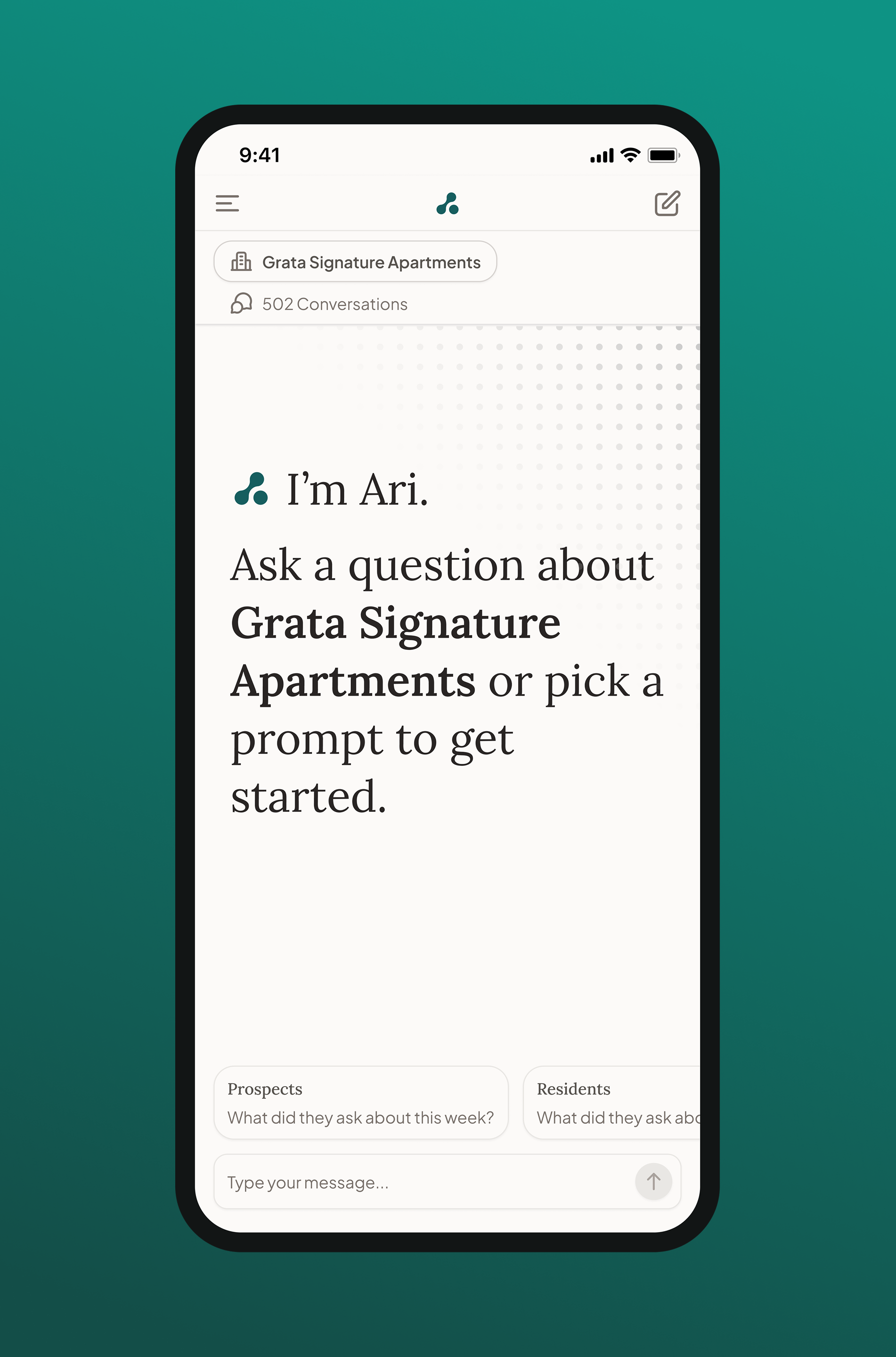
Ari, multifamily's first AI-powered renter insights tool, built on Rentgrata's proprietary conversation data.
MY ROLE
Led research, product UX, and design across five sprint cycles. Ran the naming and branding workshops that gave the product its identity.
The Interesting Part
We were designing for a need clients couldn't articulate yet. The research wasn't about listening to what they asked for. It was about validating a hypothesis they didn't know they had.
What Shipped
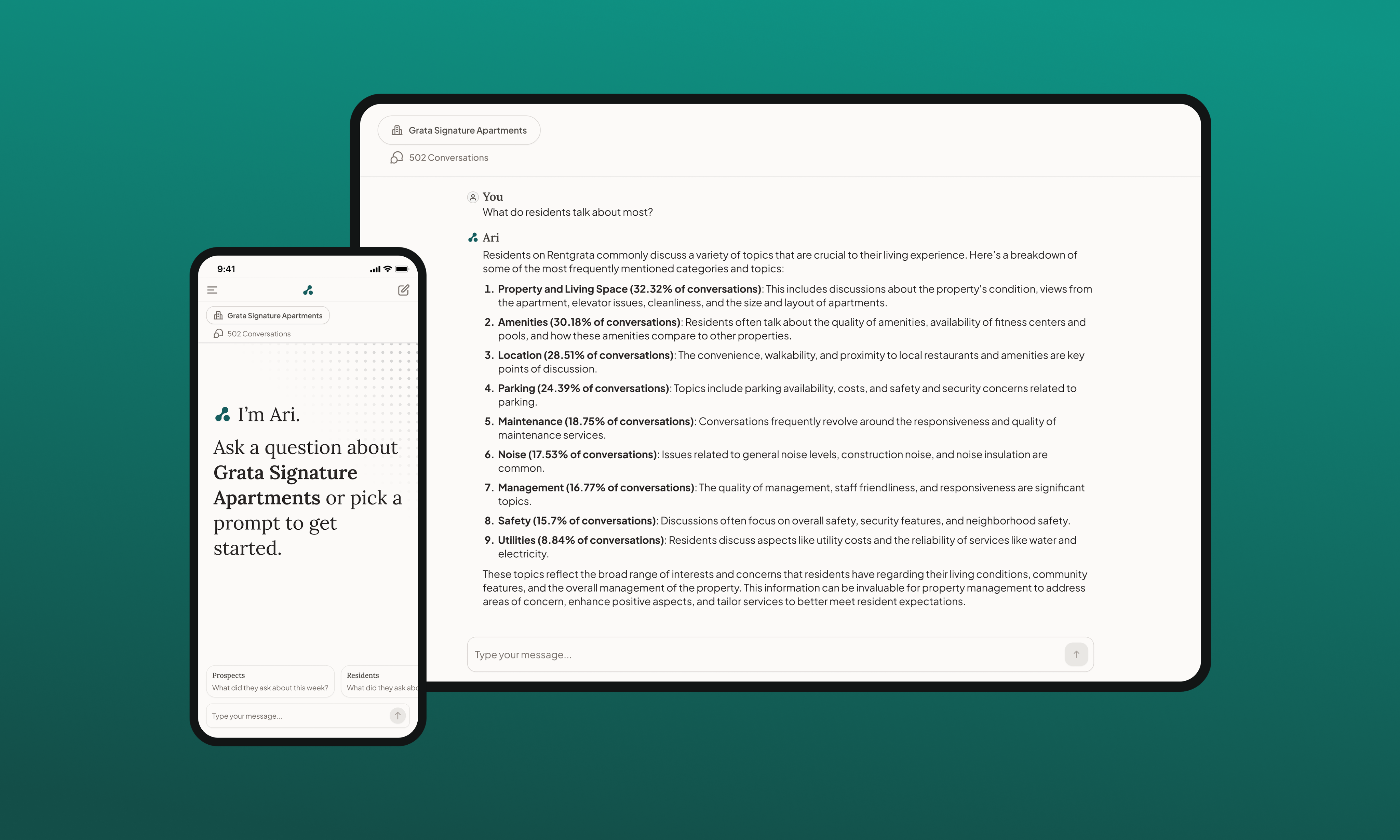
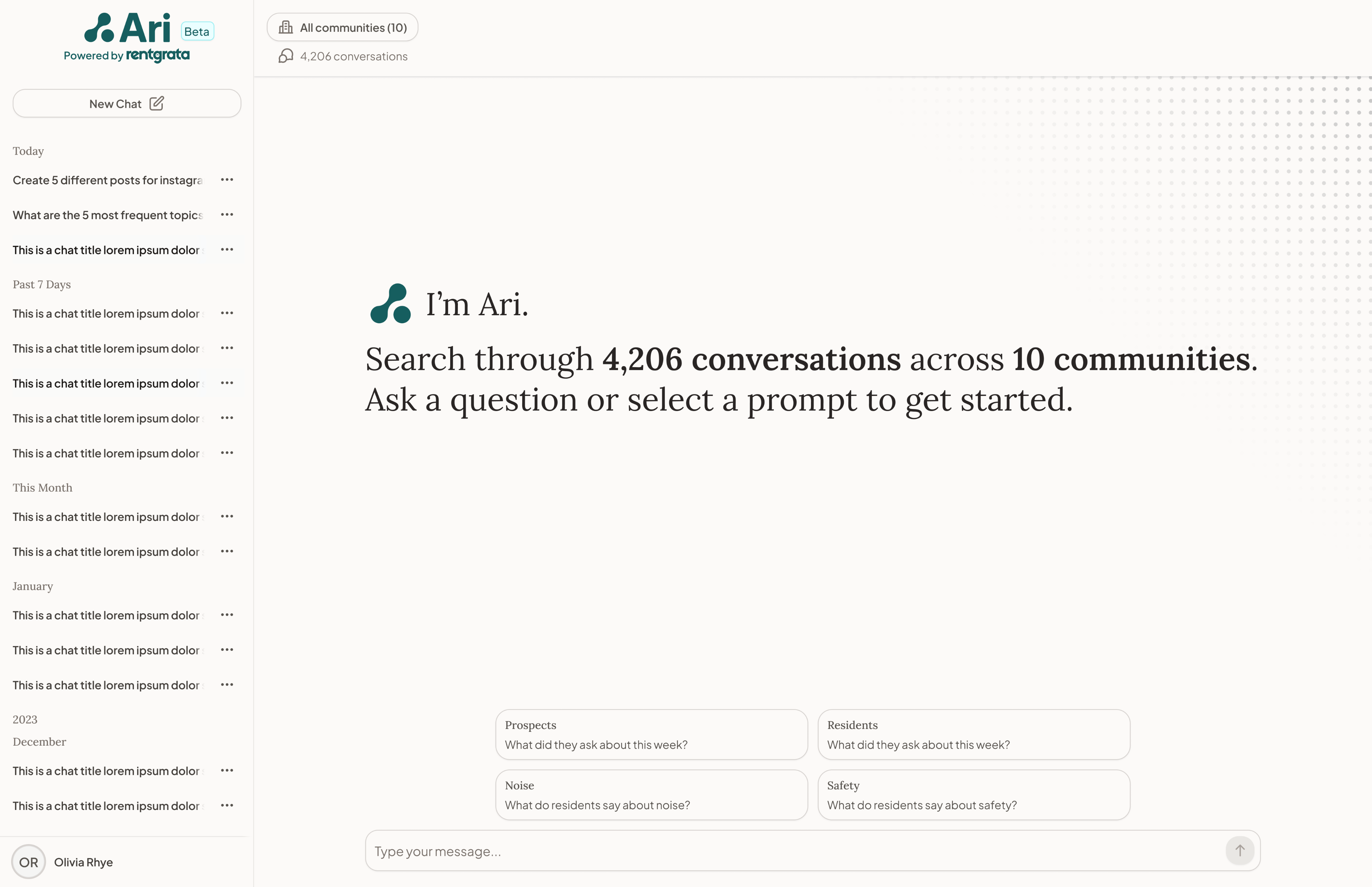
A conversational AI product that lets property managers query thousands of renter conversations in natural language, in seconds. Launched July 2024.
What Came Next
Rentgrata was acquired by Opiniion in July 2025. Ari was part of the story that made it happen.
THE PROBLEM
The data was there. Clients couldn't get to it.
Rentgrata's platform was generating thousands of authentic conversations between prospective renters and current residents. Property managers had access to one of the most valuable qualitative datasets in multifamily real estate. They could see the surface of it through dashboards and word clouds in Rentgrata Manager. What they really wanted was full transcripts.
That wasn't something we could give them. The honesty and candor of those resident conversations depended on anonymity. The moment residents thought their words could be traced back to them, the signal would degrade. So full transcripts were off the table, even if clients kept asking for them.
The design challenge wasn't just making data accessible. It was figuring out how much access to give, and what form that access should take, without compromising the thing that made the data worth having.
Early client interviews also revealed something the team hadn't expected: clients weren't thinking about AI. LLMs were still new to their world, and their mental model of what software could do hadn't expanded to include a tool that could just answer a question in plain language. They were reporting frustrations with the existing dashboard. They weren't asking for something new. We had to show them what was possible before we could ask if they wanted it.
6
Enterprise clients interviewed across two research phases

3–6 wks
Time clients were spending manually finding insight trends
Over 1 Million
Conversations in the Rentgrata dataset at launch
Existing product feedback synthesis
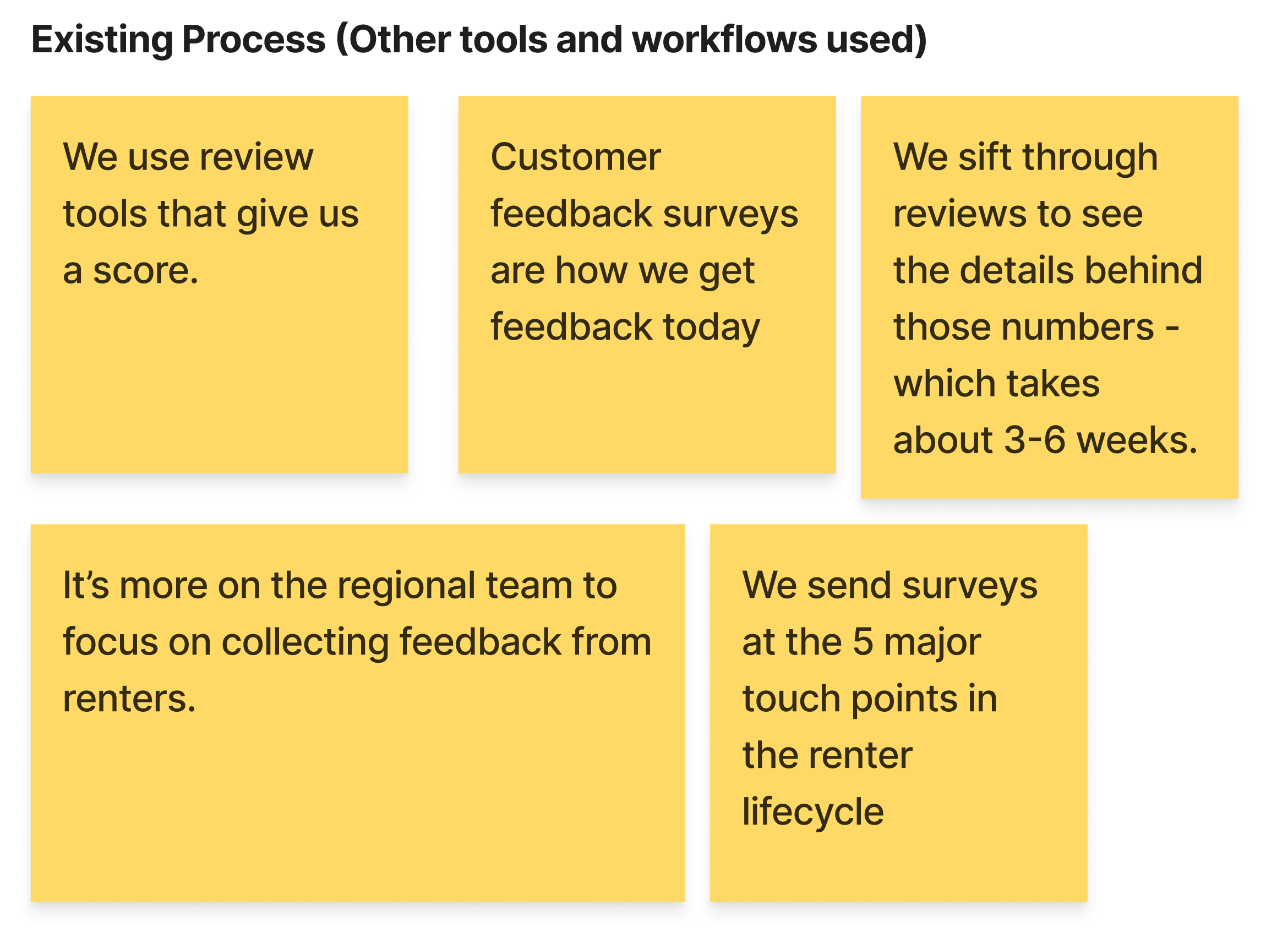
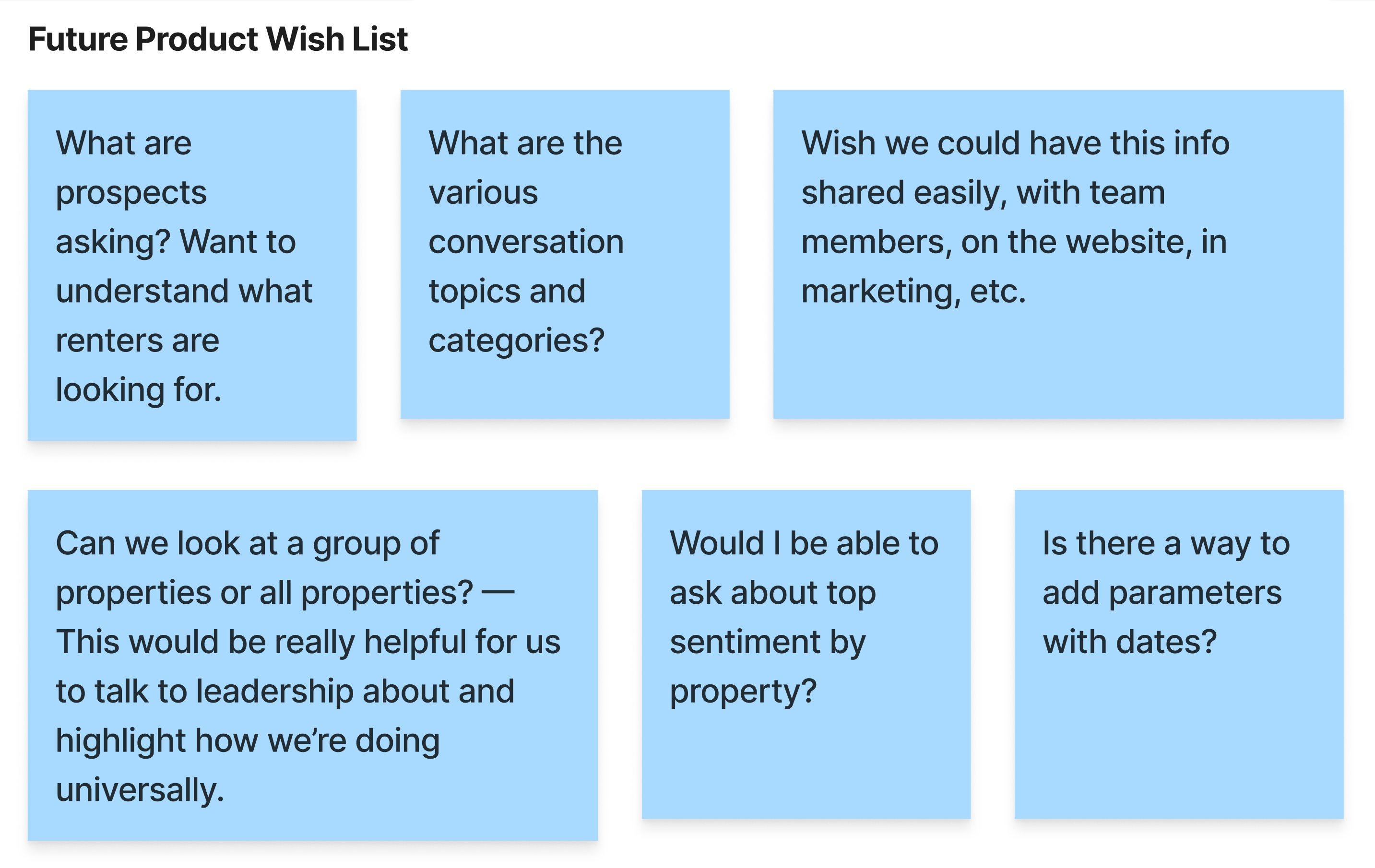
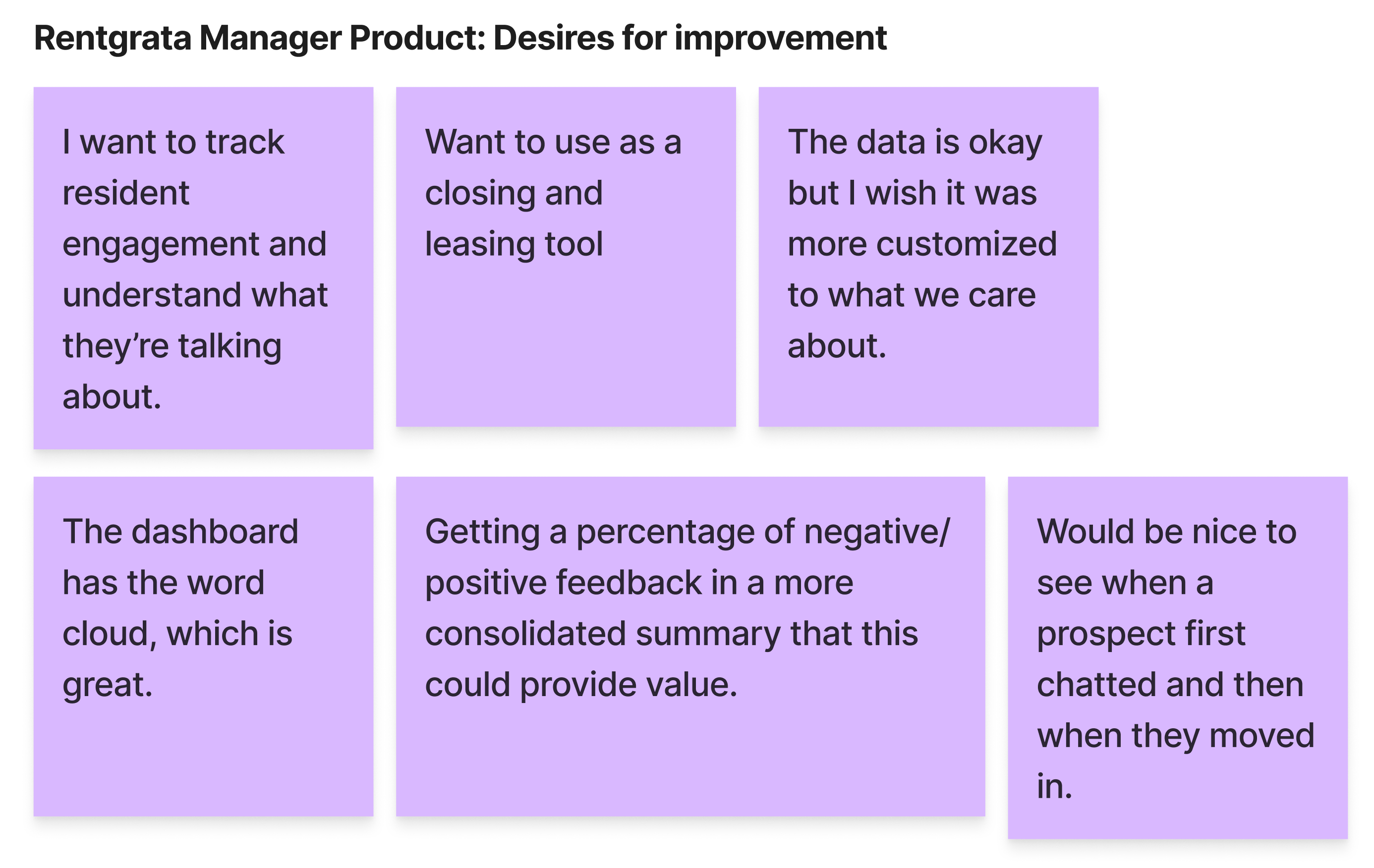
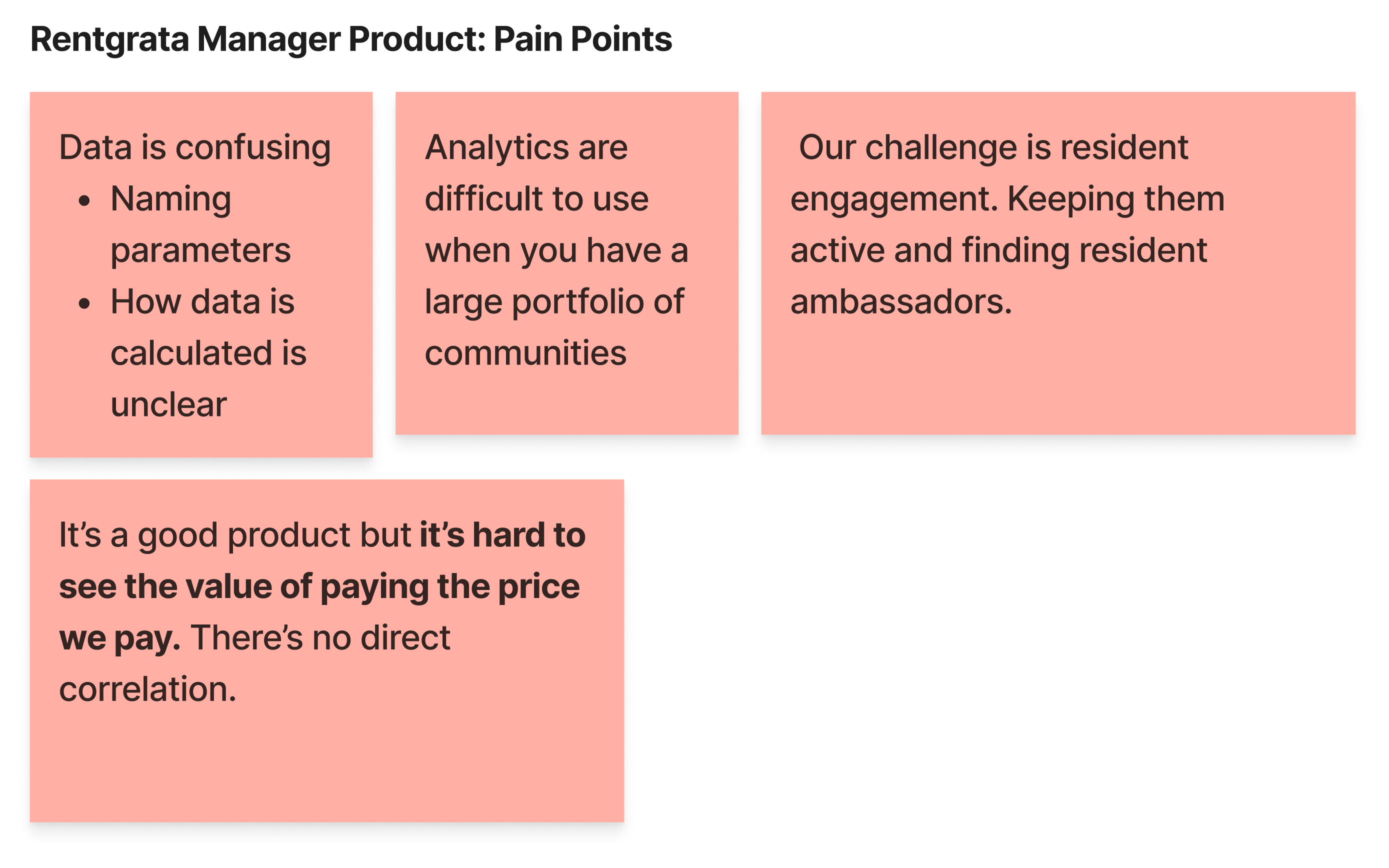
Feedback on Rentgrata Manager organized by positives, desires, pain points, and rewards. Clients saw clear value but couldn't prove ROI to leadership, and couldn't get a consolidated view without doing it manually. That gap became the brief for Ari.
THE PROCESS
Five design sprints. No roadmap. One shipped product.
When you're building a product category that doesn't exist in the industry yet, you can't plan your way to the answer. You have to learn your way there. I introduced the Sprint methodology from day one, running weekly cycles that kept design and engineering solving the same problems at the same time, with documented decisions before anyone moved on to the next thing.
Each sprint produced working prototypes across three tracks: design, frontend, and backend. At the end of every sprint, we debriefed, figured out what we'd learned, and decided what changed. Five months of that process is how a vague idea about conversation data turns into a product you can ship.
Design Sprints
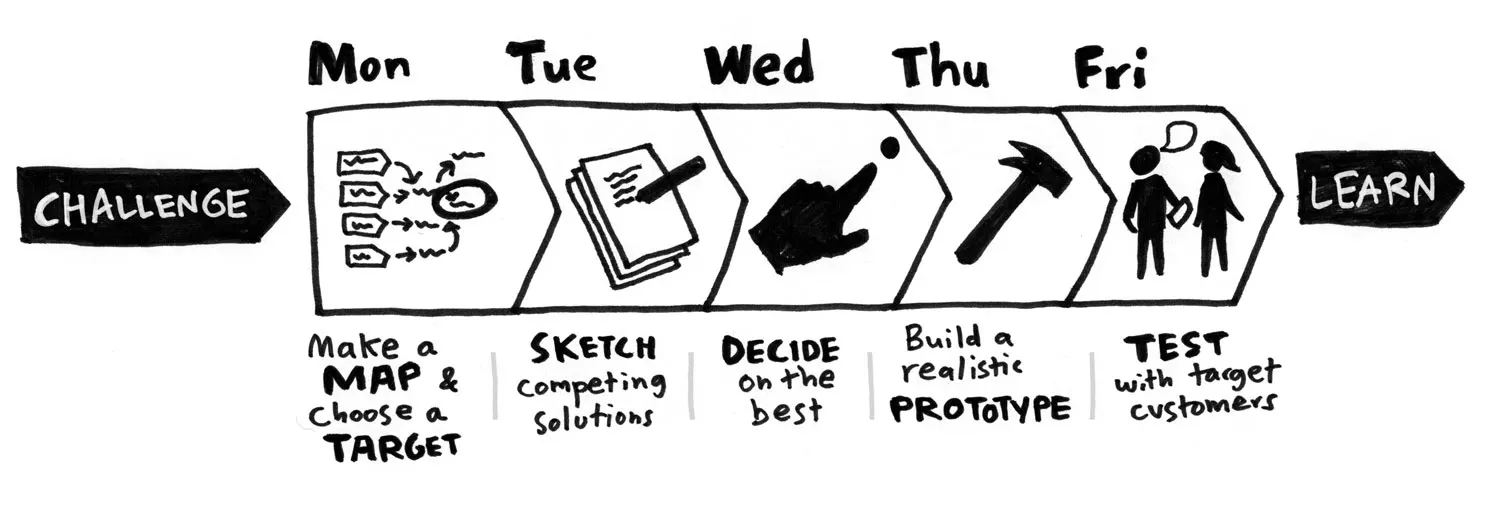
Description...
1.
Getting started
What does this thing actually do?
Mapped user stories, triaged features by likely impact, and built the first storyboard and prototype. The backend hit hard limits immediately: 30-second response timeouts, no streaming yet. We logged the constraints and kept moving. Sprint 1 wasn't about building something complete. It was about figuring out what to build next.
2.
User persona
We were designing for the wrong person.
A structured "how could we fail" exercise surfaced a real risk: Community Managers weren't the right fit. We ran a team vote, and shifted the primary persona to Regional Managers, who had cross-portfolio visibility and purchasing authority. Everything downstream changed because of it.
3.
Technical breakthrough
The product got a voice.
We introduced SQL to the model and it worked. That unlocked structural queries against the actual data, not just semantic searches. The interface started introducing itself: "Hi there, I'm RGenie." We built sharing flows, notifications, and the first onboarding experience. Vellum came online as the AI orchestration layer.
4.
Beyond functionality
Going to production, with one question still open.
We designed a full credit and paywall system while engineering moved into production development. CI/CD, authentication, architecture, documentation. The product worked. What it didn't have yet was an identity. The sprint closed with one open item: "Personality, voice, tone, brand. Unknown what we need at this time."
5.
Brand discovery workshop
Time to name this thing.
Design language and brand discovery became official sprint agenda items. Engineering got their architecture in order. I ran the naming workshop that took the product from an internal codename to something real. By the end of Sprint 5, we had a working product and a name worth shipping under.
TRADEOFFS
The calls that shaped what launched.
Most of the interesting decisions in this project weren't about pixels. They were about what kind of product to build, who to build it for, and what to leave on the table.
What We chose
Validate with live prototypes rather than concept descriptions. Clients couldn't imagine this without seeing it.
Regional Managers as the primary audience, after the Sprint 2 persona shift
A conversational AI interface rather than an expanded traditional dashboard
Drop the credit system before launch to reduce adoption friction
Run the naming workshop before finalizing the visual design
Keep Ari inside the Rentgrata brand as "Powered by Rentgrata"
What We Left Behind
Waiting for clients to ask for this. They didn't have the vocabulary yet.
A visual AI avatar or character. The wrong context for B2B enterprise clients.
A traditional PRD-driven process. The sprint format replaced it entirely.
Monetizing at launch. Adoption came first.
A standalone Ari brand identity, separate from Rentgrata
Retool as the frontend framework. We outgrew it by Sprint 2.
On the credit system: We designed multiple paywall flow options, credit deduction logic, out-of-credits notifications, etc. Then we dropped it before launch.
The decision was straightforward in the end: adoption mattered more than early revenue, and a paywall was the most direct path to zero engagement. Scoping it carefully meant we understood exactly what we were setting aside and could pick it up later.
What Changed
Research changed the product. Workshops gave it a name.
The use case we didn't see coming...
The original assumption was that Regional Managers would use Ari primarily for performance reporting: how many conversations, which properties are converting, what's the trend. What the research showed was that the highest-value use case was marketing intelligence.
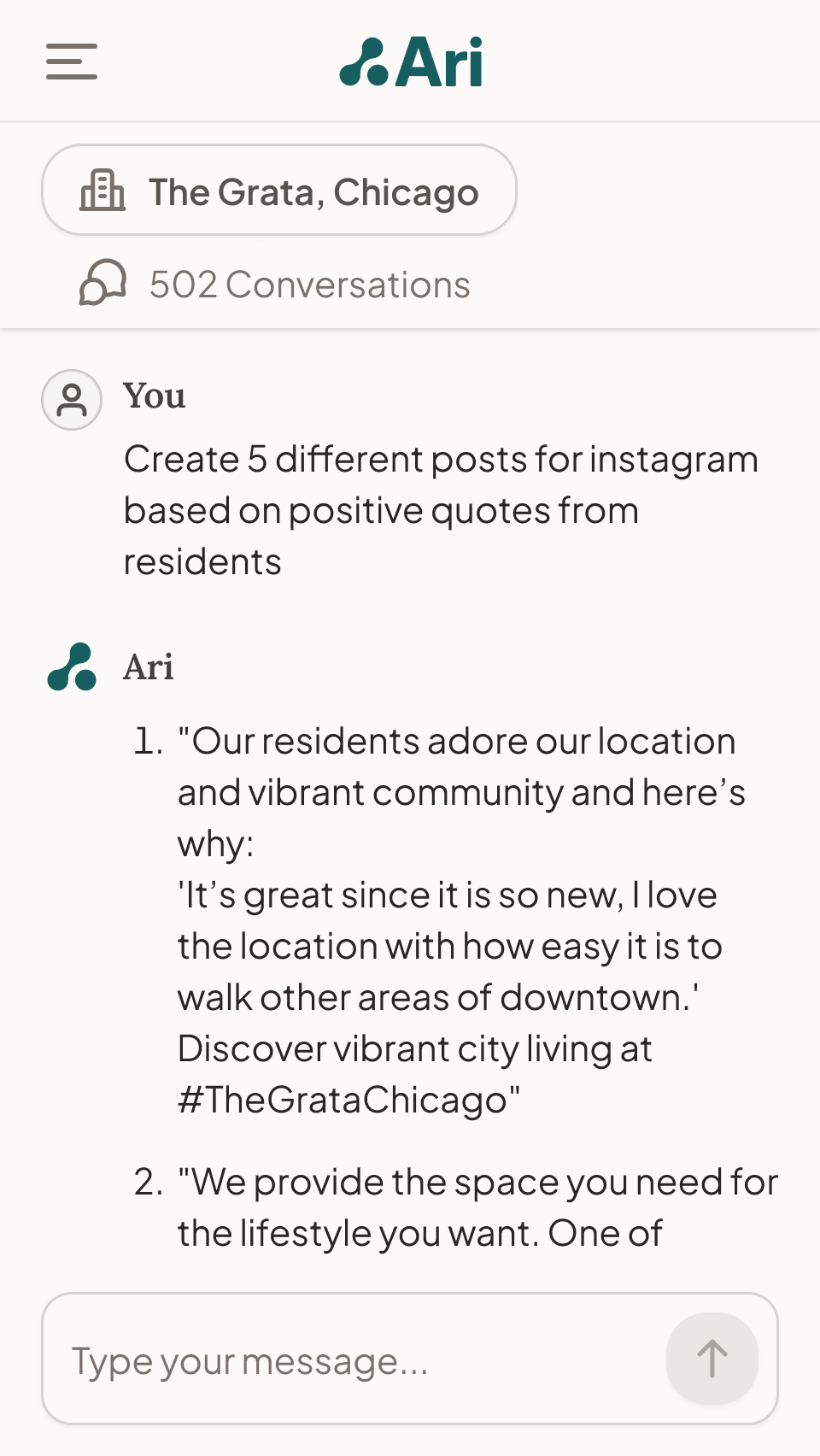
Clients wanted to understand what prospects were asking about. What language residents used when they described a property. What kept showing up in conversations week after week at a particular community. That kind of signal, instantly queryable, would change how they wrote copy, chose ad creative, and ran campaigns. "I could quickly ask it to pull data that I would typically need to pull manually." That sentence from one client interview drove the content generation capability visible in the shipped product.
What the research kept surfacing about adoption
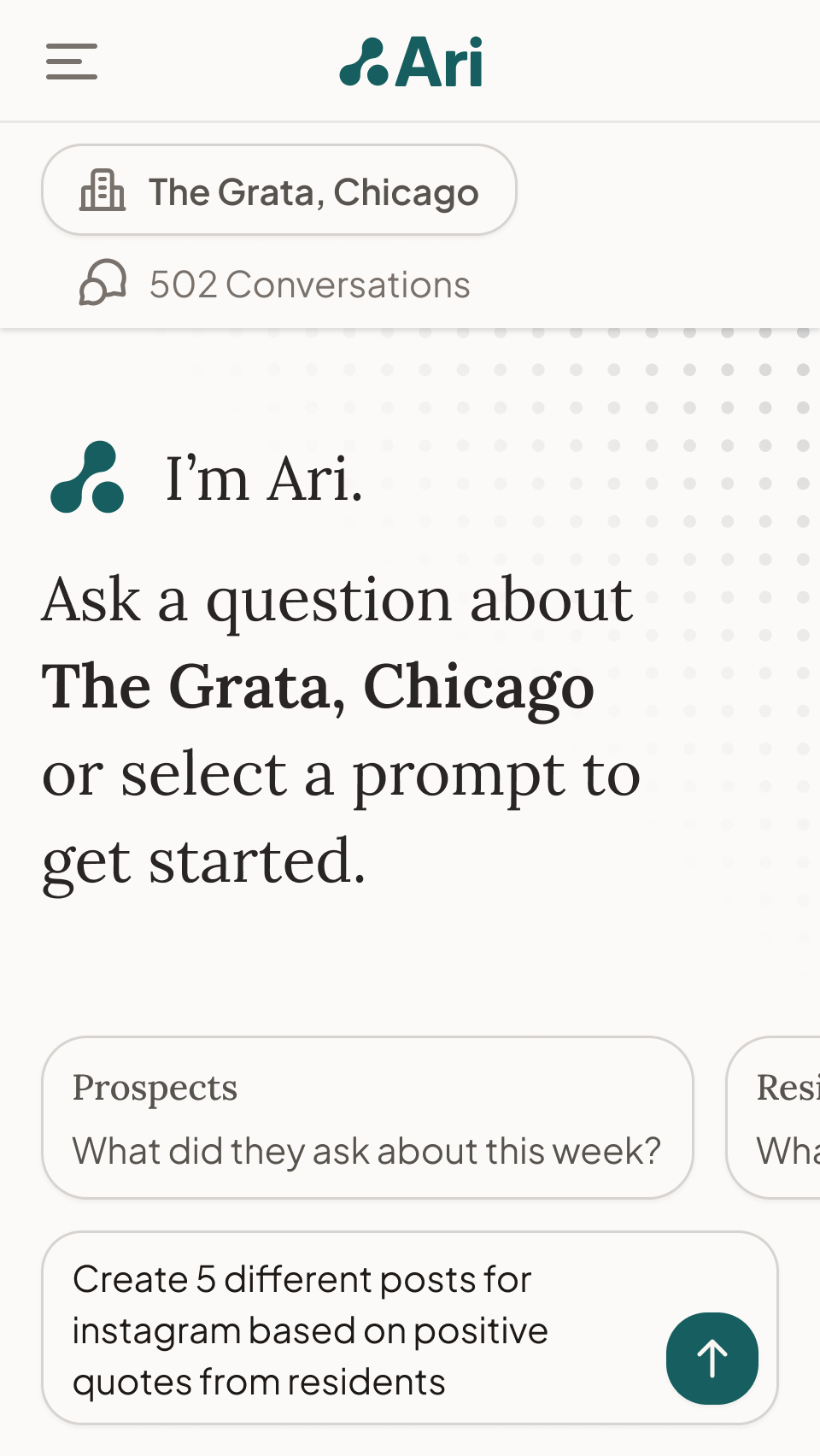
Across every client interview, a version of the same concern came up: more tools means more work. Leasing teams were already managing multiple platforms. A new product, however useful, had to feel like it was reducing cognitive load, not adding another interface to check. That shaped the entire UX philosophy. Ari had to answer questions without requiring the user to think hard about how to ask them. The suggested prompts, the simple community switcher, the single-column mobile layout were all direct responses to that feedback.
Naming the product
By Sprint 5, we had a working product with no name. I designed and ran a brand naming workshop, building on the methodology and brand foundations from the Rentgrata rebrand work the team had already done together. The workshop moved through brand naming education, a word bank exercise, a benefits breakdown, a combination round, and then a vote.
Three names made the final round: RGenie, Ari, and Brainstorm. Ari won because it did something the others didn't. It worked as an acronym (Actionable Renter Insights) and as a name. Human, approachable, genderless. The kind of name you could say out loud in a meeting without it sounding like software.
Naming workshop and Educating stakeholders
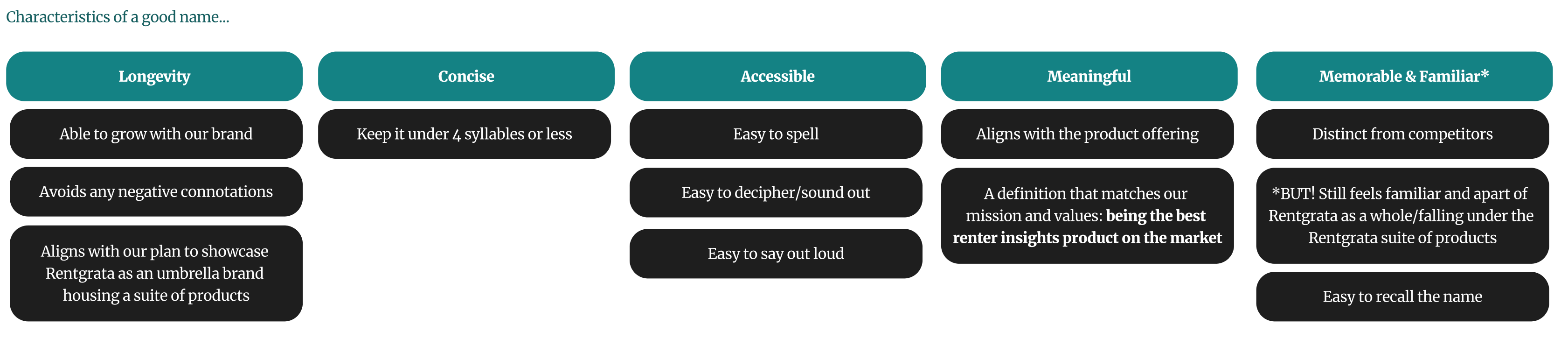
Before any brainstorming began, I ran a naming education module to give the team a shared framework. The slide defined five criteria a good name should meet: longevity, concision, accessibility, meaning, and memorability. Real brand examples grounded the criteria in practice, so the team was evaluating ideas against a rubric rather than gut feeling.
Final name vote
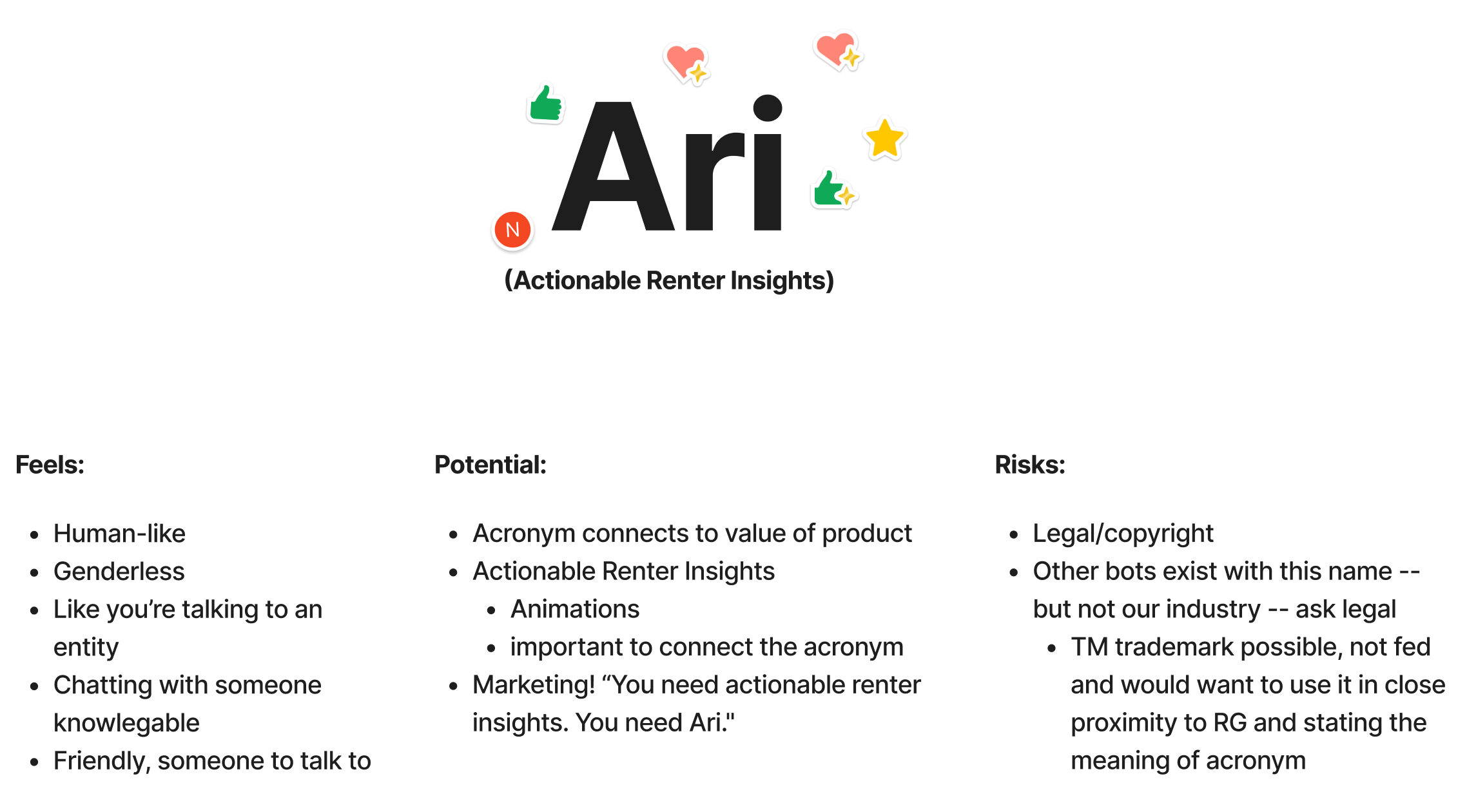
Each name evaluated across Feels, Potential, and Risks. Ari cleared all three.
Logo Exploration
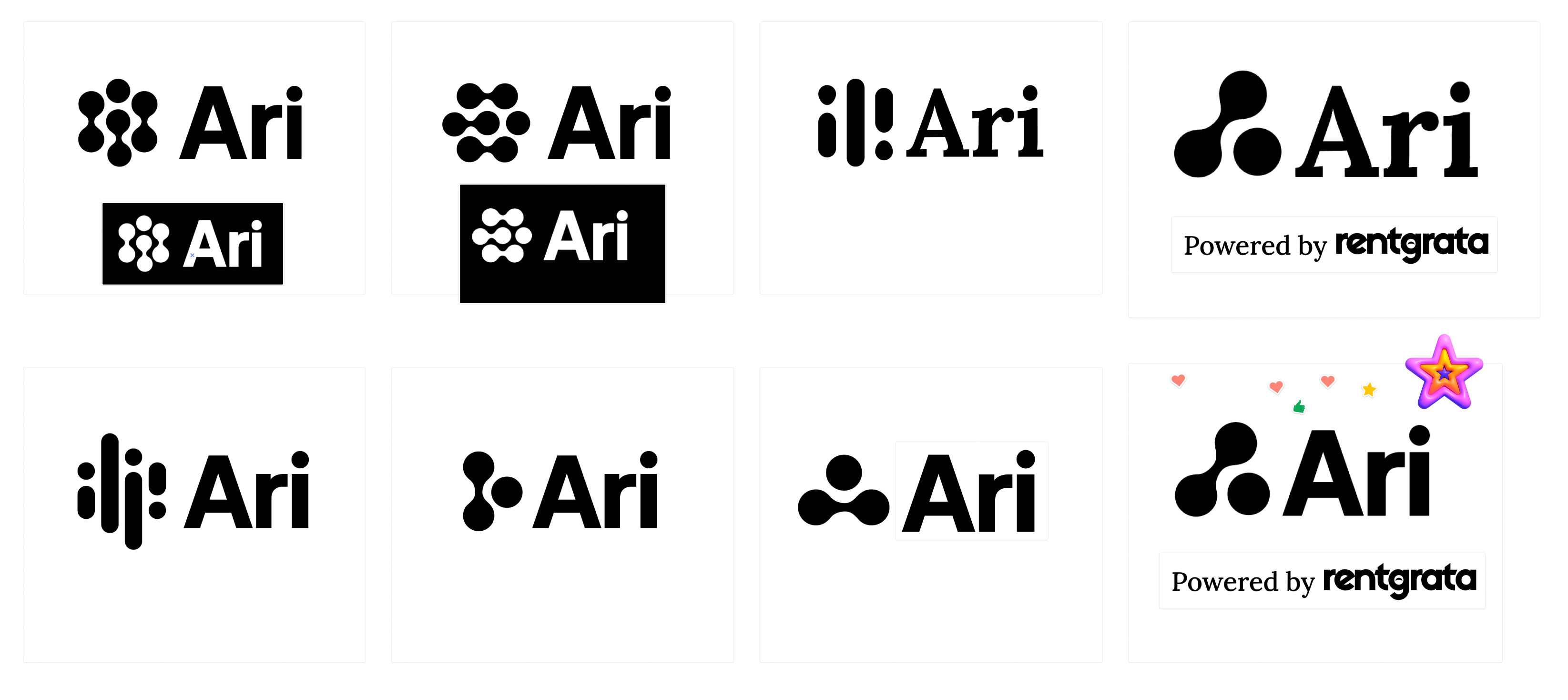
Five rounds of logo work, narrowing to a mark that reads as connected data points, referencing both conversation and insight.
What Shipped
Ari, launched July 2024.
Live with real clients, on real data, answering real questions from day one.
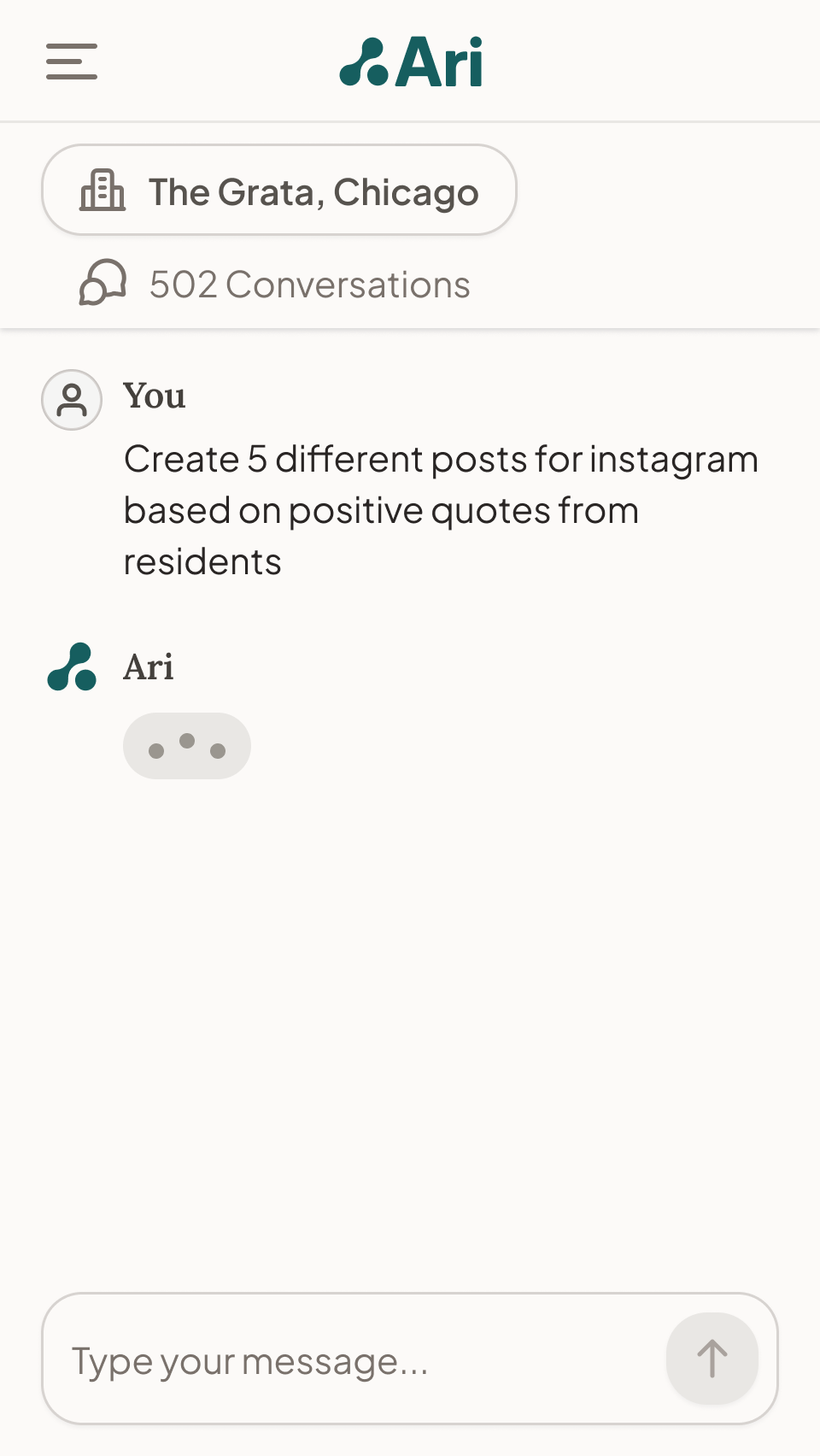
Ari MVP: Mobile
What I Learned
What this project taught me about building in ambiguity.
On Process
Weekly sprints replace the need for a roadmap.
In a project this open-ended, trying to plan six months ahead would have been a waste of time. The sprint structure meant every week had a clear question to answer and a documented decision at the end. That was enough.
On Research
Showing is more useful than asking.
Clients couldn't tell us what they wanted because they'd never seen it. Running demos before we were "ready" unlocked the most useful feedback in the entire project. The post-demo interviews were where the real requirements lived.
On Tradeoffs
Privacy constraints can make a product better.
Not providing full transcripts forced us to design something more useful: a tool that surfaces patterns and insights rather than raw data. Clients got what they actually needed rather than what they thought they wanted.
On Naming
Brand decisions are design decisions.
Running the naming workshop before finalizing the visual design meant the product's name and personality informed the interface rather than being attached to it afterward. Everything felt more coherent as a result.

Let’s chat

© 2026 Nina Haglund
NINA HAGLUND
About
Resume
Contact
Building Ari: Multifamily's First AI-Powered Renter Insights Product
Role
Lead Product Designer
Skills
0 to 1 Product Design, User Research, Branding
Shipped
July 2024
OVERVIEW
Rentgrata is a resident referral platform that connects prospective renters with the people who know a property best — The residents who live there.
Those conversations had been accumulating for years, building a proprietary dataset that most companies in multifamily could only dream about. Clients were seeing some data in the Rentgrata Manager product through dashboards and word clouds, but they wanted to dig deeper.
Ari gave them a way in: a conversational AI product that surfaces what renters are actually saying, at scale, without exposing the individual voices behind the data.
WHAT IT WAS
Ari, multifamily's first AI-powered renter insights tool, built on Rentgrata's proprietary conversation data.
MY ROLE
Led research, product UX, and design across five sprint cycles. Ran the naming and branding workshops that gave the product its identity.
The Interesting Part
We were designing for a need clients couldn't articulate yet. The research wasn't about listening to what they asked for. It was about validating a hypothesis they didn't know they had.
What Shipped
A conversational AI product that lets property managers query thousands of renter conversations in natural language, in seconds. Launched July 2024.
What Came Next
Rentgrata was acquired by Opiniion in July 2025. Ari was part of the story that made it happen.
THE PROBLEM
The data was there. Clients couldn't get to it.
Rentgrata's platform was generating thousands of authentic conversations between prospective renters and current residents. Property managers had access to one of the most valuable qualitative datasets in multifamily real estate. They could see the surface of it through dashboards and word clouds in Rentgrata Manager. What they really wanted was full transcripts.
That wasn't something we could give them. The honesty and candor of those resident conversations depended on anonymity. The moment residents thought their words could be traced back to them, the signal would degrade. So full transcripts were off the table, even if clients kept asking for them.
The design challenge wasn't just making data accessible. It was figuring out how much access to give, and what form that access should take, without compromising the thing that made the data worth having.
Early client interviews also revealed something the team hadn't expected: clients weren't thinking about AI. LLMs were still new to their world, and their mental model of what software could do hadn't expanded to include a tool that could just answer a question in plain language. They were reporting frustrations with the existing dashboard. They weren't asking for something new. We had to show them what was possible before we could ask if they wanted it.
6
Enterprise clients interviewed across two research phases

3–6 wks
Time clients were spending manually finding insight trends
Over 1 Million
Conversations in the Rentgrata dataset at launch
Existing product feedback synthesis
THE PROCESS
Five design sprints. No roadmap. One shipped product.
When you're building a product category that doesn't exist in the industry yet, you can't plan your way to the answer. You have to learn your way there. I introduced the Sprint methodology from day one, running weekly cycles that kept design and engineering solving the same problems at the same time, with documented decisions before anyone moved on to the next thing.
Each sprint produced working prototypes across three tracks: design, frontend, and backend. At the end of every sprint, we debriefed, figured out what we'd learned, and decided what changed. Five months of that process is how a vague idea about conversation data turns into a product you can ship.
Design Sprints
Description...
1.
Getting started
What does this thing actually do?
Mapped user stories, triaged features by likely impact, and built the first storyboard and prototype. The backend hit hard limits immediately: 30-second response timeouts, no streaming yet. We logged the constraints and kept moving. Sprint 1 wasn't about building something complete. It was about figuring out what to build next.
2.
User persona
We were designing for the wrong person.
A structured "how could we fail" exercise surfaced a real risk: Community Managers weren't the right fit. We ran a team vote, and shifted the primary persona to Regional Managers, who had cross-portfolio visibility and purchasing authority. Everything downstream changed because of it.
3.
Technical breakthrough
The product got a voice.
We introduced SQL to the model and it worked. That unlocked structural queries against the actual data, not just semantic searches. The interface started introducing itself: "Hi there, I'm RGenie." We built sharing flows, notifications, and the first onboarding experience. Vellum came online as the AI orchestration layer.
4.
Beyond functionality
Going to production, with one question still open.
We designed a full credit and paywall system while engineering moved into production development. CI/CD, authentication, architecture, documentation. The product worked. What it didn't have yet was an identity. The sprint closed with one open item: "Personality, voice, tone, brand. Unknown what we need at this time."
5.
Brand discovery workshop
Time to name this thing.
Design language and brand discovery became official sprint agenda items. Engineering got their architecture in order. I ran the naming workshop that took the product from an internal codename to something real. By the end of Sprint 5, we had a working product and a name worth shipping under.
TRADEOFFS
The calls that shaped what launched.
Most of the interesting decisions in this project weren't about pixels. They were about what kind of product to build, who to build it for, and what to leave on the table.
What We chose
Validate with live prototypes rather than concept descriptions. Clients couldn't imagine this without seeing it.
Regional Managers as the primary audience, after the Sprint 2 persona shift
A conversational AI interface rather than an expanded traditional dashboard
Drop the credit system before launch to reduce adoption friction
Run the naming workshop before finalizing the visual design
Keep Ari inside the Rentgrata brand as "Powered by Rentgrata"
What We Left Behind
Waiting for clients to ask for this. They didn't have the vocabulary yet.
A visual AI avatar or character. The wrong context for B2B enterprise clients.
A traditional PRD-driven process. The sprint format replaced it entirely.
Monetizing at launch. Adoption came first.
A standalone Ari brand identity, separate from Rentgrata
Retool as the frontend framework. We outgrew it by Sprint 2.
On the credit system: We designed multiple paywall flow options, credit deduction logic, out-of-credits notifications, etc. Then we dropped it before launch.
The decision was straightforward in the end: adoption mattered more than early revenue, and a paywall was the most direct path to zero engagement. Scoping it carefully meant we understood exactly what we were setting aside and could pick it up later.
What Changed
Research changed the product. Workshops gave it a name.
The use case we didn't see coming...
The original assumption was that Regional Managers would use Ari primarily for performance reporting: how many conversations, which properties are converting, what's the trend. What the research showed was that the highest-value use case was marketing intelligence.
Clients wanted to understand what prospects were asking about. What language residents used when they described a property. What kept showing up in conversations week after week at a particular community. That kind of signal, instantly queryable, would change how they wrote copy, chose ad creative, and ran campaigns. "I could quickly ask it to pull data that I would typically need to pull manually." That sentence from one client interview drove the content generation capability visible in the shipped product.
What the research kept surfacing about adoption
Across every client interview, a version of the same concern came up: more tools means more work. Leasing teams were already managing multiple platforms. A new product, however useful, had to feel like it was reducing cognitive load, not adding another interface to check. That shaped the entire UX philosophy. Ari had to answer questions without requiring the user to think hard about how to ask them. The suggested prompts, the simple community switcher, the single-column mobile layout were all direct responses to that feedback.
Naming the product
By Sprint 5, we had a working product with no name. I designed and ran a brand naming workshop, building on the methodology and brand foundations from the Rentgrata rebrand work the team had already done together. The workshop moved through brand naming education, a word bank exercise, a benefits breakdown, a combination round, and then a vote.
Three names made the final round: RGenie, Ari, and Brainstorm. Ari won because it did something the others didn't. It worked as an acronym (Actionable Renter Insights) and as a name. Human, approachable, genderless. The kind of name you could say out loud in a meeting without it sounding like software.
Naming workshop and Educating stakeholders
Before any brainstorming began, I ran a naming education module to give the team a shared framework. The slide defined five criteria a good name should meet: longevity, concision, accessibility, meaning, and memorability. Real brand examples grounded the criteria in practice, so the team was evaluating ideas against a rubric rather than gut feeling.
Final name vote
The moment "Ari = Actionable Renter Insights" emerged as an acronym candidate. A name that earns its meaning rather than just describing the product. Each name evaluated across Feels, Potential, and Risks. Ari cleared all three.
Logo exploration
Five rounds of logo work, narrowing to a mark that reads as connected data points, referencing both conversation and insight.
What Shipped
Ari, launched July 2024.
Live with real clients, on real data, answering real questions from day one.
Ari Mvp
What I Learned
What this project taught me about building in ambiguity.
On Process
Weekly sprints replace the need for a roadmap.
In a project this open-ended, trying to plan six months ahead would have been a waste of time. The sprint structure meant every week had a clear question to answer and a documented decision at the end. That was enough.
On Research
Showing is more useful than asking.
Clients couldn't tell us what they wanted because they'd never seen it. Running demos before we were "ready" unlocked the most useful feedback in the entire project. The post-demo interviews were where the real requirements lived.
On Tradeoffs
Privacy constraints can make a product better.
Not providing full transcripts forced us to design something more useful: a tool that surfaces patterns and insights rather than raw data. Clients got what they actually needed rather than what they thought they wanted.
On Naming
Brand decisions are design decisions.
Running the naming workshop before finalizing the visual design meant the product's name and personality informed the interface rather than being attached to it afterward. Everything felt more coherent as a result.
Let’s chat
© 2026 Nina Haglund
NINA HAGLUND
About
Resume
Contact
Building Ari: Multifamily's First AI-Powered Renter Insights Product
Role
Lead Product Designer
Skills
0 to 1 Product Design, User Research, Branding
Shipped
July 2024
OVERVIEW
Rentgrata is a resident referral platform that connects prospective renters with the people who know a property best — The residents who live there.
Those conversations had been accumulating for years, building a proprietary dataset that most companies in multifamily could only dream about. Clients were seeing some data in the Rentgrata Manager product through dashboards and word clouds, but they wanted to dig deeper.
Ari gave them a way in: a conversational AI product that surfaces what renters are actually saying, at scale, without exposing the individual voices behind the data.
WHAT IT WAS
Ari, multifamily's first AI-powered renter insights tool, built on Rentgrata's proprietary conversation data.
MY ROLE
Led research, product UX, and design across five sprint cycles. Ran the naming and branding workshops that gave the product its identity.
The Interesting Part
We were designing for a need clients couldn't articulate yet. The research wasn't about listening to what they asked for. It was about validating a hypothesis they didn't know they had.
What Shipped
A conversational AI product that lets property managers query thousands of renter conversations in natural language, in seconds. Launched July 2024.
What Came Next
Rentgrata was acquired by Opiniion in July 2025. Ari was part of the story that made it happen.
THE PROBLEM
The data was there. Clients couldn't get to it.
Rentgrata's platform was generating thousands of authentic conversations between prospective renters and current residents. Property managers had access to one of the most valuable qualitative datasets in multifamily real estate. They could see the surface of it through dashboards and word clouds in Rentgrata Manager. What they really wanted was full transcripts.
That wasn't something we could give them. The honesty and candor of those resident conversations depended on anonymity. The moment residents thought their words could be traced back to them, the signal would degrade. So full transcripts were off the table, even if clients kept asking for them.
The design challenge wasn't just making data accessible. It was figuring out how much access to give, and what form that access should take, without compromising the thing that made the data worth having.
Early client interviews also revealed something the team hadn't expected: clients weren't thinking about AI. LLMs were still new to their world, and their mental model of what software could do hadn't expanded to include a tool that could just answer a question in plain language. They were reporting frustrations with the existing dashboard. They weren't asking for something new. We had to show them what was possible before we could ask if they wanted it.
6
Enterprise clients interviewed across two research phases
3–6 wks
Time clients were spending manually finding insight trends
Over 1 Million
Conversations in the Rentgrata dataset at launch
Existing product feedback synthesis
THE PROCESS
Five design sprints. No roadmap. One shipped product.
When you're building a product category that doesn't exist in the industry yet, you can't plan your way to the answer. You have to learn your way there. I introduced the Sprint methodology from day one, running weekly cycles that kept design and engineering solving the same problems at the same time, with documented decisions before anyone moved on to the next thing.
Each sprint produced working prototypes across three tracks: design, frontend, and backend. At the end of every sprint, we debriefed, figured out what we'd learned, and decided what changed. Five months of that process is how a vague idea about conversation data turns into a product you can ship.
Design Sprints
The persona decision tree from Sprint 2. The team worked through tradeoffs for Regional Managers vs. Marketing Directors vs. Community Managers and voted. The shift to Regional Managers held through every sprint that followed.
1.
Getting started
What does this thing actually do?
Mapped user stories, triaged features by likely impact, and built the first storyboard and prototype. The backend hit hard limits immediately: 30-second response timeouts, no streaming yet. We logged the constraints and kept moving. Sprint 1 wasn't about building something complete. It was about figuring out what to build next.
2.
User persona
We were designing for the wrong person.
A structured "how could we fail" exercise surfaced a real risk: Community Managers weren't the right fit. We ran a team vote, and shifted the primary persona to Regional Managers, who had cross-portfolio visibility and purchasing authority. Everything downstream changed because of it.
3.
Technical breakthrough
The product got a voice.
We introduced SQL to the model and it worked. That unlocked structural queries against the actual data, not just semantic searches. The interface started introducing itself: "Hi there, I'm RGenie." We built sharing flows, notifications, and the first onboarding experience. Vellum came online as the AI orchestration layer.
4.
Beyond functionality
Going to production, with one question still open.
We designed a full credit and paywall system while engineering moved into production development. CI/CD, authentication, architecture, documentation. The product worked. What it didn't have yet was an identity. The sprint closed with one open item: "Personality, voice, tone, brand. Unknown what we need at this time."
5.
Brand discovery workshop
Time to name this thing.
Design language and brand discovery became official sprint agenda items. Engineering got their architecture in order. I ran the naming workshop that took the product from an internal codename to something real. By the end of Sprint 5, we had a working product and a name worth shipping under.
TRADEOFFS
The calls that shaped what launched.
Most of the interesting decisions in this project weren't about pixels. They were about what kind of product to build, who to build it for, and what to leave on the table.
What We chose
Validate with live prototypes rather than concept descriptions. Clients couldn't imagine this without seeing it.
Regional Managers as the primary audience, after the Sprint 2 persona shift
A conversational AI interface rather than an expanded traditional dashboard
Drop the credit system before launch to reduce adoption friction
Run the naming workshop before finalizing the visual design
Keep Ari inside the Rentgrata brand as "Powered by Rentgrata"
What We Left Behind
Waiting for clients to ask for this. They didn't have the vocabulary yet.
A visual AI avatar or character. The wrong context for B2B enterprise clients.
A traditional PRD-driven process. The sprint format replaced it entirely.
Monetizing at launch. Adoption came first.
A standalone Ari brand identity, separate from Rentgrata
Retool as the frontend framework. We outgrew it by Sprint 2.
On the credit system: We designed multiple paywall flow options, credit deduction logic, out-of-credits notifications, etc. Then we dropped it before launch.
The decision was straightforward in the end: adoption mattered more than early revenue, and a paywall was the most direct path to zero engagement. Scoping it carefully meant we understood exactly what we were setting aside and could pick it up later.
What Changed
Research changed the product. Workshops gave it a name.
The use case we didn't see coming...
The original assumption was that Regional Managers would use Ari primarily for performance reporting: how many conversations, which properties are converting, what's the trend. What the research showed was that the highest-value use case was marketing intelligence.
Clients wanted to understand what prospects were asking about. What language residents used when they described a property. What kept showing up in conversations week after week at a particular community. That kind of signal, instantly queryable, would change how they wrote copy, chose ad creative, and ran campaigns. "I could quickly ask it to pull data that I would typically need to pull manually." That sentence from one client interview drove the content generation capability visible in the shipped product.
What the research kept surfacing about adoption
Across every client interview, a version of the same concern came up: more tools means more work. Leasing teams were already managing multiple platforms. A new product, however useful, had to feel like it was reducing cognitive load, not adding another interface to check. That shaped the entire UX philosophy. Ari had to answer questions without requiring the user to think hard about how to ask them. The suggested prompts, the simple community switcher, the single-column mobile layout were all direct responses to that feedback.
Naming the product
By Sprint 5, we had a working product with no name. I designed and ran a brand naming workshop, building on the methodology and brand foundations from the Rentgrata rebrand work the team had already done together. The workshop moved through brand naming education, a word bank exercise, a benefits breakdown, a combination round, and then a vote.
Three names made the final round: RGenie, Ari, and Brainstorm. Ari won because it did something the others didn't. It worked as an acronym (Actionable Renter Insights) and as a name. Human, approachable, genderless. The kind of name you could say out loud in a meeting without it sounding like software.
Naming workshop and Educating stakeholders
Before any brainstorming began, I ran a naming education module to give the team a shared framework. The slide defined five criteria a good name should meet: longevity, concision, accessibility, meaning, and memorability. Real brand examples grounded the criteria in practice, so the team was evaluating ideas against a rubric rather than gut feeling.
Final name vote
The moment "Ari = Actionable Renter Insights" emerged as an acronym candidate. A name that earns its meaning rather than just describing the product. Each name evaluated across Feels, Potential, and Risks. Ari cleared all three.
Logo exploration
Five rounds of logo work, narrowing to a mark that reads as connected data points, referencing both conversation and insight.
What Shipped
Ari, launched July 2024.
Live with real clients, on real data, answering real questions from day one.
Ari MVP
What I Learned
What this project taught me about building in ambiguity.
On Process
Weekly sprints replace the need for a roadmap.
In a project this open-ended, trying to plan six months ahead would have been a waste of time. The sprint structure meant every week had a clear question to answer and a documented decision at the end. That was enough.
On Research
Showing is more useful than asking.
Clients couldn't tell us what they wanted because they'd never seen it. Running demos before we were "ready" unlocked the most useful feedback in the entire project. The post-demo interviews were where the real requirements lived.
On Tradeoffs
Privacy constraints can make a product better.
Not providing full transcripts forced us to design something more useful: a tool that surfaces patterns and insights rather than raw data. Clients got what they actually needed rather than what they thought they wanted.
On Naming
Brand decisions are design decisions.
Running the naming workshop before finalizing the visual design meant the product's name and personality informed the interface rather than being attached to it afterward. Everything felt more coherent as a result.
Let’s chat
© 2026 Nina Haglund